
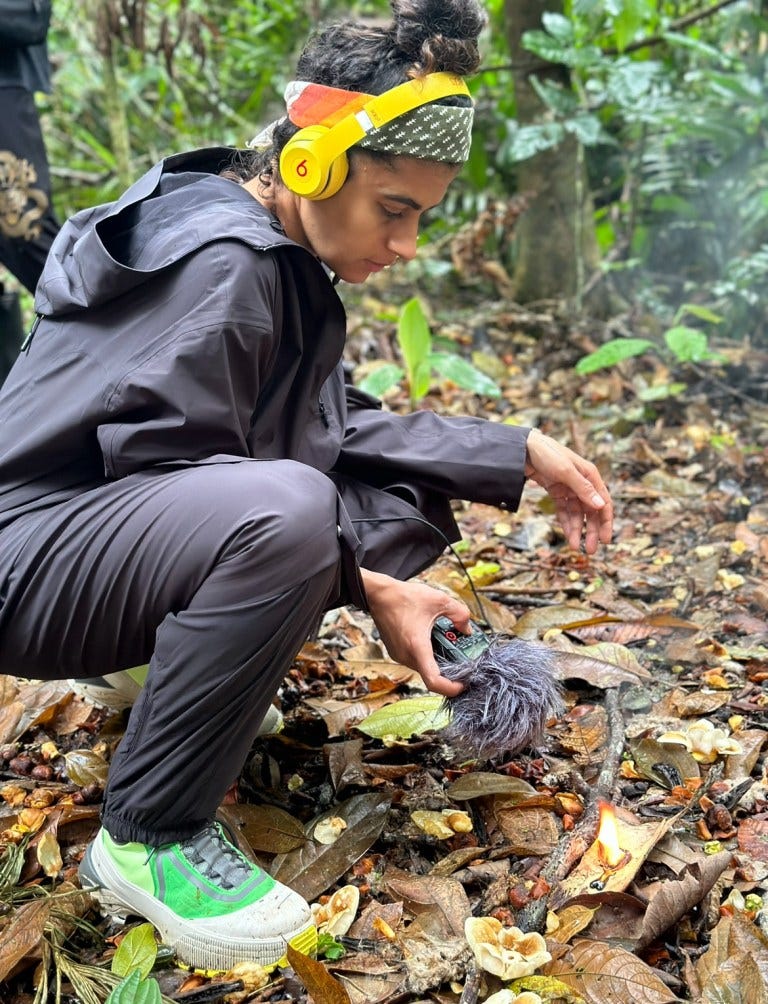
Imagine yourself somewhere else. Close your eyes and imagine a rainforest. Madame Gandhi is there, microphones in tow, capturing all kinds of audio. With her, you find out what the rainforest tells us about freshness, sonic life, and the urgent need for healthier human behaviours. This is someone who was the first digital analyst at Interscope Records, who’s drummed live with Thievery Corporation and M.I.A but also someone who promotes music education among incarcerated people. She’s an artist, an activist, a 2020 TED Fellow, and a recipient of the Orchestral Tools Microgrant. I’ve found a very nuanced approach to technology with her. She sees it as a kind of bridge between inner truth and outside impact.
This is the first of a series of interviews around tech, future music design, and creativity that centre around the recipients of the Orchestral Tools Microgrants. Madame Gandhi kicks us off with a masterclass in how to use tech with intent. In our interview, she showcased a keen awareness of the relationship between the creator and the tool. Similarly, she thinks deeply about the spectrum of how sound generates purpose and how the living world is basically her studio.
The discipline of slow tech
There’s a tendency around music-tech circles, and tech more generally speaking, to chase the next update and the fastest workflow. I’ve certainly written about this before. I get the feeling Madame Gandhi moves at a different pace.
“I love the discipline and container and deadline of academics. I enjoy the rigor of studying and acquiring new skills. I apply this way of being and training in project managing my musical projects and gently adapting new tech! It creates self trust. I learn slowly but foundationally.”
That last part – “I learn slowly but foundationally” – is something I want to print on a t-shirt. It almost feels rebellious against that pressure to constantly chase novelty and new things. What’s more, her academic training evidently taught her how to learn and how to trust herself when faced with new tools. It might help that in her MA Music Science and Technology at Stanford’s CCRMA she got to build her own microphones. She kind of knows tech like she knows music.
Call it a form of tech-literacy as self-knowledge. In a moment where it seems like you can make an LLM do anything you want if you have the requisite domain knowledge, having dual foundational knowledge of tech and music allows Madame Gandhi to be well-positioned. This reflected in this response about what one piece of new tech she would invent to solve a problem today:
“I’m actually really enjoying the Suno AI integrations – I enjoy deciding how creatively I’d integrated an ai generated stem into a larger creative body of my work. I’d generate things that are not always my skill set like supporting melodies to a top line.”
I want to say that her academic background helps in evaluating AI output critically. This seems a clear case of using AI to extend the creative work. It’s about integrating the tool into her workflow and keeping a firm handle on the structure of a song.
The choosing wand
The hydrophone (an underwater microphone) Madame Gandhi built during her studies at Stanford travels with her. She’s using it right now, as this newsletter hits your inbox, in the Amazon. It’s also joined her on travels to Antarctica, where it helped her record the sound of melting glaciers, penguins and more. I’ve written before about the ‘gray zone’ and how our musical bodies help ground us into that zone. Madame Gandhi extends this grounding body to the environment around us. She uses her field recordings to take what’s raw sounds into a variety of drums and melodies.
“When I record in the rainforest, nature waits for no one. So it is beautiful to have a simple and streamlined and prepared tech set up. I use a Sony A10 mic, the LOM Audio MikroUsi mics, my own hydrophone and a simple old pair of yellow Beats headphones to get the job done.”
That’s it, simplicity wins. There’s a fluency here between working with advanced tech like Suno, Ableton, Orchestral Tools libraries and the set up she travels with. Advanced tech like her Manley reference microphone is the wand that chose her as a wizard. But the vocals she records with that mic get worked into an organic mix with the sounds of the rushing river she’s recording right now in the Colombian rainforest. The wand of this wizard takes many shapes, but its most important aspect is that it disappears into a workflow that fits the environment.
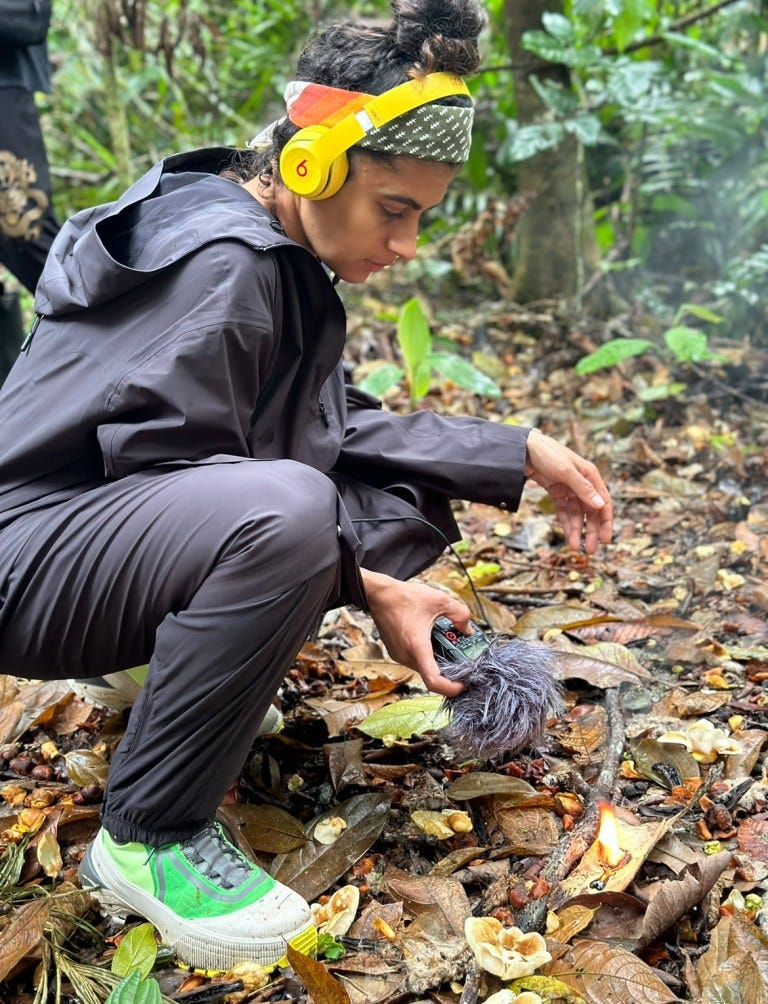
A lot of this came together in the Wild Symphony project at Calanoa Amazonas. Nature is her co-artist, and through EarthPercent is quite literally is. The Orchestral Tools libraries might seem a world removed from that rushing river but, as she put it:
“I love the sound design of the nature, the creativity and weirdness, the mix of organic instruments which you’ll find in my live band mixed with natural textures like ice and wind!!!”
This is, once more, an extension of the creative playbook of the artist. Just as with the tech, Madame Gandhi understands when to lean into the complexity and when to strip it back. She can weave together field recordings with orchestrated textural soundscapes. Throughout she honours the wild and the composed.
Coming home
I asked Madame Gandhi what the best piece of advice was she got around music and tech:
“Take your time. Build strong foundations. Be good at a few specific things.”
As a generalist myself, this feels like life advice. But it’s interesting how the foundational element resonates throughout her work. From microphones to hydrophones and from AI to sample libraries, tech serves a broader mission. Asked what she wants people to take away from her music, she wants them
“to come home to themselves, their joy, their essential contribution, their true nature.”
Whether it’s a panel talk, a guided meditation, her recorded music output it all focuses on helping people feel their own aliveness. We need to learn to better listen to world around us and here we are presented with a clear invitation to do so.
 Madame Gandhi | BLOG