

Story by Patricia Cullen
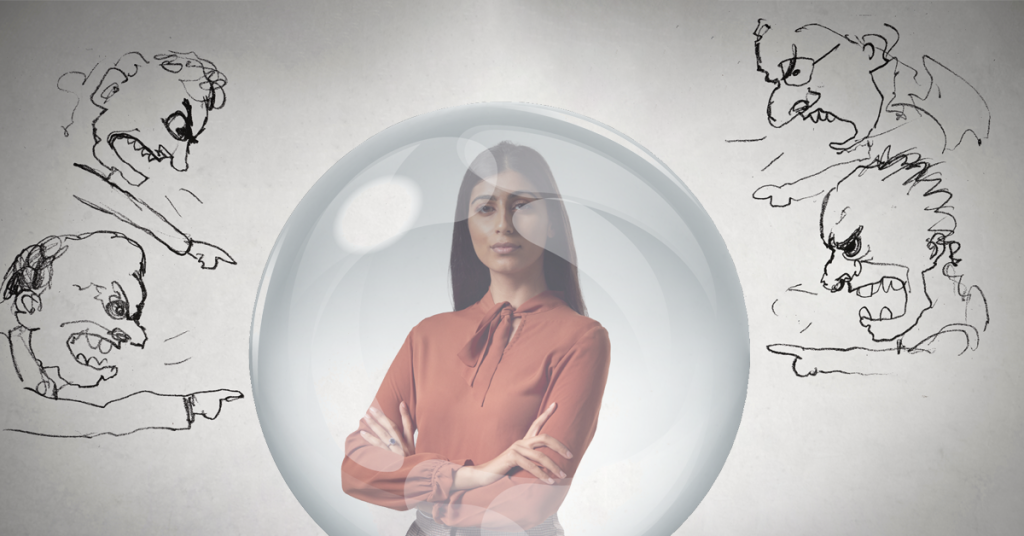
Due to society’s growing demand for social responsibility, business leaders are under more scrutiny than ever before. All leaders, irrespective of whether they are male or female, face challenges and critics. It’s an inherent part of leadership.
Female leaders can be just as responsible for terrible outcomes as male leaders. Just because a leader is female, does not mean she should not be exempt from judgement. True resilience is developed by facing obstacles head-on, learning from them and improving as a result.
The future is female
Except it’s not. This slogan experienced a rebirth since it first appeared on the scene in 1970s New York, and has recently been seized by activists, influencers, and political leaders alike. Hillary Clinton declared it in her welcome to the inaugural 2017 Makers Conference and the activist musician Madame Gandhi launched a song with the slogan. A Google search for ‘feminine leadership’ renders approximately 33 million results. However, the number of women in leadership positions has stalled globally, and participation in Parliament is at a standstill.
Alison Rose and Sharon White have it tough right now. There’s no doubt that both leaders have made mistakes. Rose fell on her sword for her handling of the Farage-Coutts saga, but a vocal minority have called out the reaction as bullying and harassment. The same vocal minority have been rushing to the defence of John Lewis Partnership Chair, White. But does this mitigation set back women’s drive for equality?
Having more women in leadership roles is crucial for the women’s movement. And Rose and White have done many things right – otherwise, they wouldn’t be where they are. The more prominent leadership positions held by women, the more society will come to accept women’s entitlement to social presence and involvement. However, the mere fact that women hold notable positions does not grant them license to engage in questionable behaviours and allow them to make bad judgements, without recourse.
Harriet Green OBE, a renowned business leader, philanthropist and former Chair & CEO of IBM Asia Pacific, says: “We won’t have true equality until we have as many great, good, average and poor female leaders as the world experiences with men! At the moment we still have more CEOs globally called Dave than we have female CEOs.”
The blame game
New research by researchers at the University of East Anglia in the UK and University of Melbourne and Monash University in Australia, finds that female leaders are given the benefit of the doubt when they do not achieve positive results. The results reveal that in the case of failure, men are assigned more blame than women.
These results could be due to benevolent sexism. In contrast to hostile sexism, benevolent sexism frequently results in prosocial behaviours towards women. Such biases in the review process, nevertheless, have a negative impact. Gender biases in assessments that favour women may impede their careers and, in the long run, raise the likelihood of backlash against female leaders.
However, Dr Melissa Carr, Director of EDI at Henley Business School’s World of Work Institute, says that there is a wealth of research to demonstrate that far from being exempt from criticism, women are more likely to be subject to it in various ways.
“Some of this research has focused on the glass cliff, a concept used to explain how women are more likely to achieve leadership positions when companies, or indeed countries (think Theresa May and Brexit) are in times of crisis.
“These leadership positions, therefore, are more precarious and high risk. In addition, women in leadership are consistently in a minority position. While some women may have broken through the glass ceiling, their minority status means they are highly visible, their actions often subject to increased scrutiny, and they are held to higher standards,” she says.
Toxic
Diversity in leadership is good for business. Across all contemporary industrialised societies, women remain underrepresented in boardrooms and governments, holding fewer than 6% of CEO positions at S&P 500 companies.
Even when women leaders are taken as seriously as the men, it can be a poisoned chalice. According to Barbara Santini, Psychologist and Relationship Adviser, when female leaders face criticism, there can be a swift and overpowering protective response from both men and women.
“This is the ‘Overprotection Paradox.’ By rushing to shield women from criticism, we inadvertently perpetuate the idea that they’re inherently more fragile or less capable than men.
“By immediately labelling criticism as bullying or harassment, we deprive female leaders of the chance to display and develop their resilience. This not only undermines their growth but also reinforces stereotypes of female emotional vulnerability,” she adds.
Just like their male counterparts, female leaders make mistakes. Accountability for leaders, whether men or women, is endemic to our systems. Always rushing to back females, is doing a disservice. Juliet Turnbull, Founder & CEO at 2to3days, acknowledges that to create a sustainable and inclusive economy, it’s important that women take up leadership positions.
“When they do, what is equally important for future progress is that male and female leaders are held to the same level of rigorous scrutiny and that they conduct themselves to the highest levels of integrity.
“Any other behaviour belittles women and underestimates the contribution they are capable of making to our economy,” she adds.
Reframing the Narrative
Research shows that companies with more women on their boards outperform those without by a significant margin, and organisations with greater gender diversity among senior leaders are more profitable.
Santini believes that for true progress, the narrative needs a shift.
“Women in leadership should be celebrated for their accomplishments and also be held accountable for their actions, just as their male counterparts are. They should be seen as capable of handling feedback, growing from challenges, and leading with strength and resilience.”
“Real empowerment comes from facing adversity and emerging stronger, not from being shielded from it. If society truly aims for gender equality, it’s crucial to recognise and rectify these subtle undermining behaviours. Only then can we genuinely create a business landscape where all leaders are evaluated and supported based on their merit, not their gender,” she adds.
The abuse of the hard-won rights for women by poor female leaders is concealed beneath the gender debate. Poor managers are poor managers. Regardless of gender, they need to receive criticism and be held accountable.
According to Carr, research shows that women face a double bind where gendered stereotypes create a no-win situation for women; there is a trade-off between being either likeable or competent.
“Rather than a setback in the drive to equality, it is important that we acknowledge ways in which women and people of colour can face systemic disadvantage and bias,” she says.
The proof is in the pudding. Female leaders can bring more success, more profit, and more growth to businesses. But to achieve true equality female leaders must own their mistakes, and the public freely condemns a decision, irrelevant of whether a male or female made it.
 Madame Gandhi | BLOG